Health determinants
Access to healthcareedit
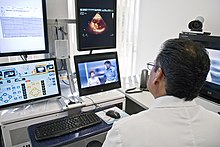
People in rural areas generally have less access to healthcare than their urban counterparts. Fewer medical practitioners, mental health programs, and healthcare facilities in these areas often mean less preventative care and longer response times in emergencies. The lack of healthcare workers has resulted in unconventional ways of delivering healthcare to rural dwellers, including medical consultations by phone or internet as well as mobile preventative care and treatment programs. There have been increased efforts to attract health professionals to isolated locations, such as increasing the number of medical students from rural areas and improving financial incentives for rural practices.
Canadians living in rural areas and small towns have access to half as many physicians (1 per 1,000 residents) as their urban counterparts. On average, these individuals have to travel five times the distance (an average of 10 km 6.2 mi) to access these services. They also have fewer specialized healthcare services such as dentists, dental surgeons, and social workers. One study found ambulance service was available in only 40% of the selected sites, blood and Urine testing services in one third of the sites, and only one of the 19 sites had neonatal services. Nursing service had reduced from 26.3% in 1998 to 21.1% in 2005.
The gap in services is due, in part, to the focus of funding on higher-population areas. In China, only 10% of the rural population had medical insurance in 1993, compared with 50% of urban residents. In the 1990s, only 20% of the government's public health spending went to the rural health system, which served 70% of the Chinese population. In the United States, between 1990 and 2000, 228 rural hospitals closed, leading to a reduction of 8,228 hospital beds. In 2009, patients living in rural areas of the United States were transferred to other facilities for care at a rate three times higher than that of patients in large central metropolitan areas.
Rural areas, especially in Africa, have greater difficulties in recruiting and retaining qualified and skilled professionals in the healthcare field. In Sub-Saharan Africa, urban and more prosperous areas have disproportionately more of the countries’ skilled healthcare workers. For example, urban Zambia has 20 times more doctors and over five times more nurses and midwives than the rural areas. In Malawi, 87% of its population lives in rural areas, but 96.6% of doctors are found in urban health facilities. Burkina Faso has one midwife per 8,000 inhabitants in richer zones, and one per nearly 430,000 inhabitants in the poorest zone. In South Africa alone, half of their population lives in rural areas, but only 12% of doctors actually practice there. One solution has been to develop programs designed to train women to perform home-based health care for patients in Rural Africa. One such program is African Solutions to African Problems (ASAP).
In order to improve health care availability in rural areas it is important to understand patient needs - hospitals need to use their distinct populations to their advantage. "Evaluating and processing patient feedback is important for understanding and solving quality of care issues in hospitals. It is critical for rural communities to understand their demographics in order to target specific care options. By involving patients in the process of identifying community needs and weak areas of service within the hospital, administrators can expect to see specialized patient care oriented feedback.
Working conditionsedit
Rural areas often have fewer job opportunities and higher unemployment rates than urban areas. The professions that are available are often physical in nature, including farming, forestry, fishing, manufacturing, and mining. These occupations are often accompanied by greater health and safety hazards due to the use of complex machinery, exposure to chemicals, working hours, noise pollution, harsher climates, and physical labor. Rural work forces thus report higher rates of life-threatening injuries.
Personal healthedit
Lifestyle and personal health choices also affect the health and expected longevity of individuals in rural areas. People from rural areas report higher rates of smoking, exposure to second-hand smoke, and obesity than those in urban areas. These individuals also lead more sedentary lives according to research conducted by the CDC. Additionally, rural areas often have low rates of fruit and vegetable consumption even where farming is prevalent.
While homicide rates are lower in rural areas, death by injury, suicide, and poisoning are significantly more prevalent. The Australian Institute of Health and Welfare also reports higher rates of interpersonal violence in rural communities.
Physical environmentedit
In many countries a lack of critical infrastructure and development in rural areas can impair rural health. Insufficient wastewater treatment, lack of paved roads, and exposure to agricultural chemicals have been identified as additional environmental concerns for those living in rural locations. The Australian Institute of Health and Welfare reports lower water quality and increased crowding of households as factors affecting disease control in rural and remote locations.


Comments
Post a Comment